
How long should you study for the SIE?
There is no official required study time. The right timeline depends on your finance background, available hours, and how quickly practice exposes weak domains.
A practical SIE study window is often 2 to 6 weeks, or roughly 20 to 50 focused hours. Use that as a planning range, not a rule. Candidates with finance exposure may need less; cold-start candidates should plan more review and mock time.
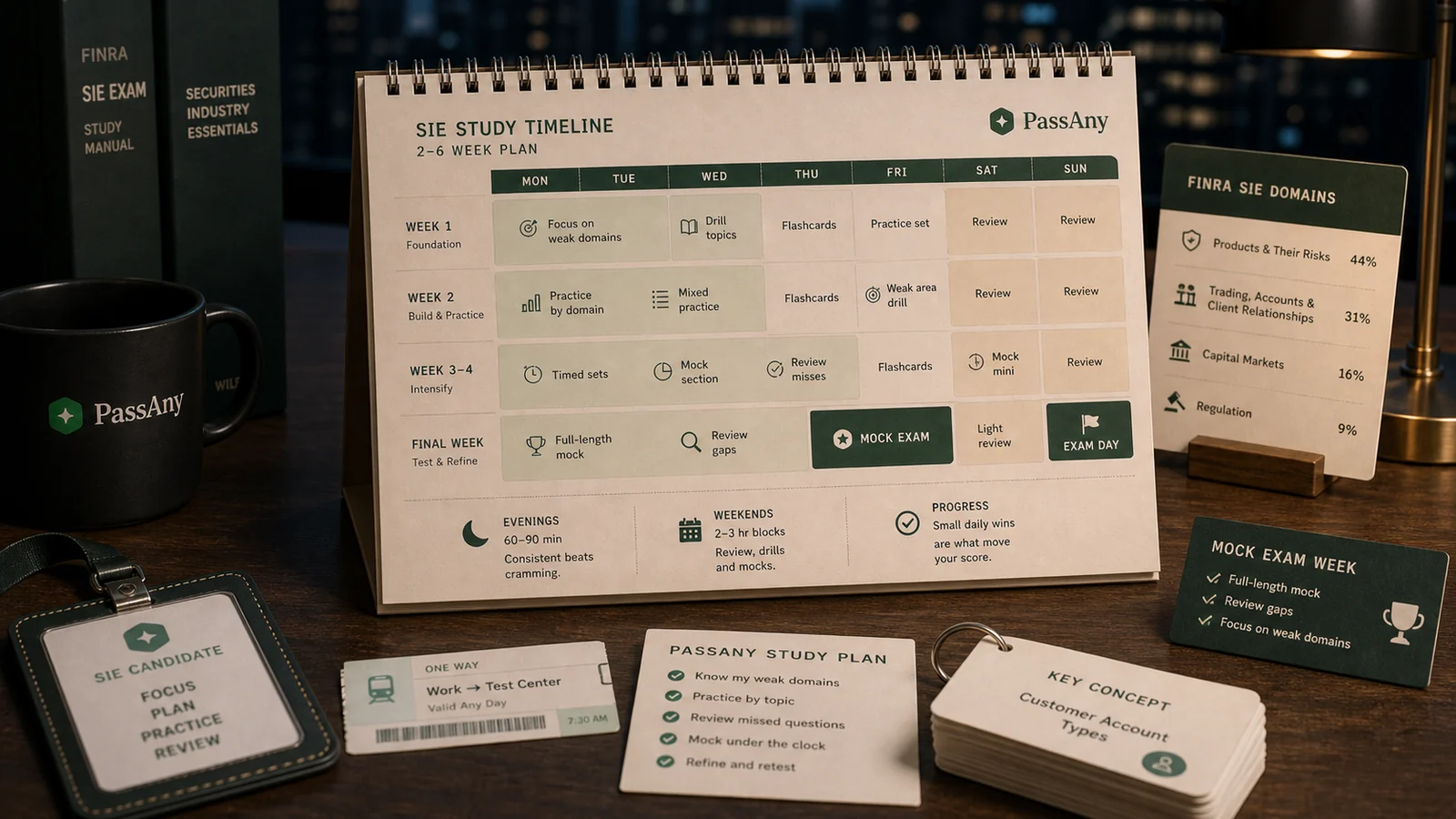
How to size your timeline
The mistake is asking only “how many weeks?” A better question is “what evidence proves I am ready?”
Vocabulary drives the first estimate.
If bonds, funds, options, and account rules are new, allow more time for explanation and repetition.
Real life changes the plan.
Working adults need a plan that survives evenings, weekends, missed days, and exam-date pressure.
Mock stability matters more than hours.
Do not sit because the calendar says so. Sit when timed scores and weak domains look stable.
Turn the guide into practice.
Reading helps, but the SIE is passed by applying the rule in mixed questions, reviewing misses, and checking timing before the appointment.
A simple 4-week SIE plan
Use the timeline as a scaffold, then adjust based on missed questions. If Products and Risks keeps lagging, it should steal time from topics you already know.
Use this checklist
- Week 1: overview, capital markets, product basics, and a diagnostic.
- Week 2: debt, equity, funds, options, annuities, and risk-return tradeoffs.
- Week 3: accounts, orders, prohibited activities, regulation, and flashcards.
- Week 4: timed mocks, missed-question review, and score stabilization.
Study time questions
How many hours should I study for the SIE?
Can I study for the SIE in one week?
What should I study first?
When should I take a mock exam?
Keep moving through the SIE path.
Prepare for the SIE with a plan, not random review.
Start with free practice, then use explanations, flashcards, mock exams and a daily study plan to close weak domains.