
Open it and know exactly what to study today.
A day-by-day SIE plan built around your exam date and your scores — a countdown, a readiness trajectory toward your target, this week's schedule and today's short task list. It re-plans itself as your results change.
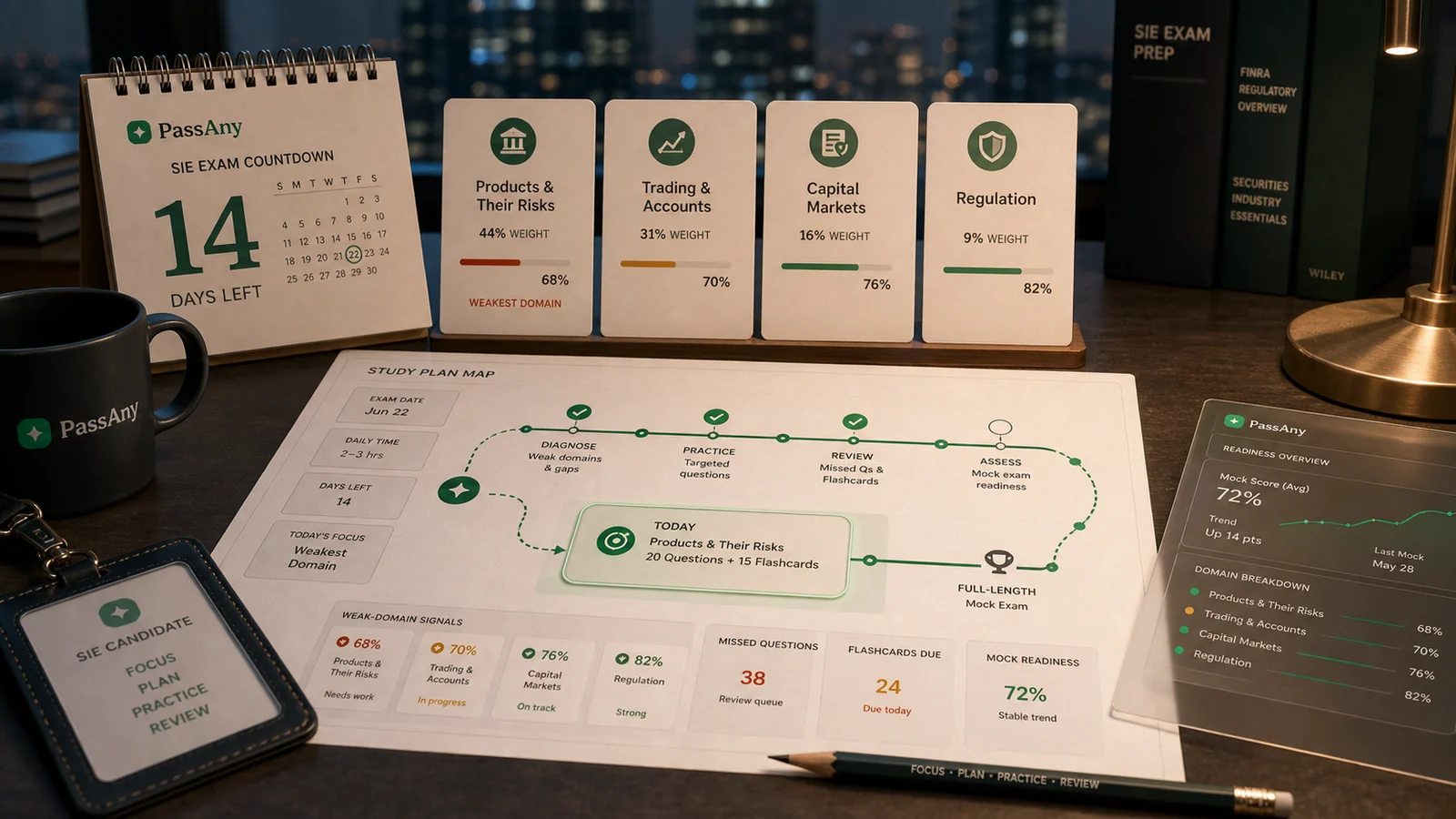
The hard part isn't finding SIE material. It's choosing the right next task.
Anyone can open another PDF, video or quiz. The real question is what deserves today's limited study time — and whether you're actually on pace for your exam date.
You shouldn't start each session deciding what to do.
The plan opens on a short, ordered list for today, so you start studying instead of planning.
"Enough time left" is a guess until you can see it.
A countdown and a readiness line show whether your current effort actually reaches the passing mark by exam day.
Study time leaks into topics you already know.
Priority goes to your weakest domain and your overdue review — not whatever's comfortable to re-read.
See whether you're on pace — not just the days left.
The plan opens with a countdown to your exam and a readiness line: where you are now, where you're heading, and whether today's pace gets you there. When you're behind, it tells you the one lever that moves the number most.
- Days-to-exam countdown, always in view
- Readiness now versus your target for exam day
- The biggest lever this week — usually your weakest domain
- A realistic daily time target, not an all-nighter
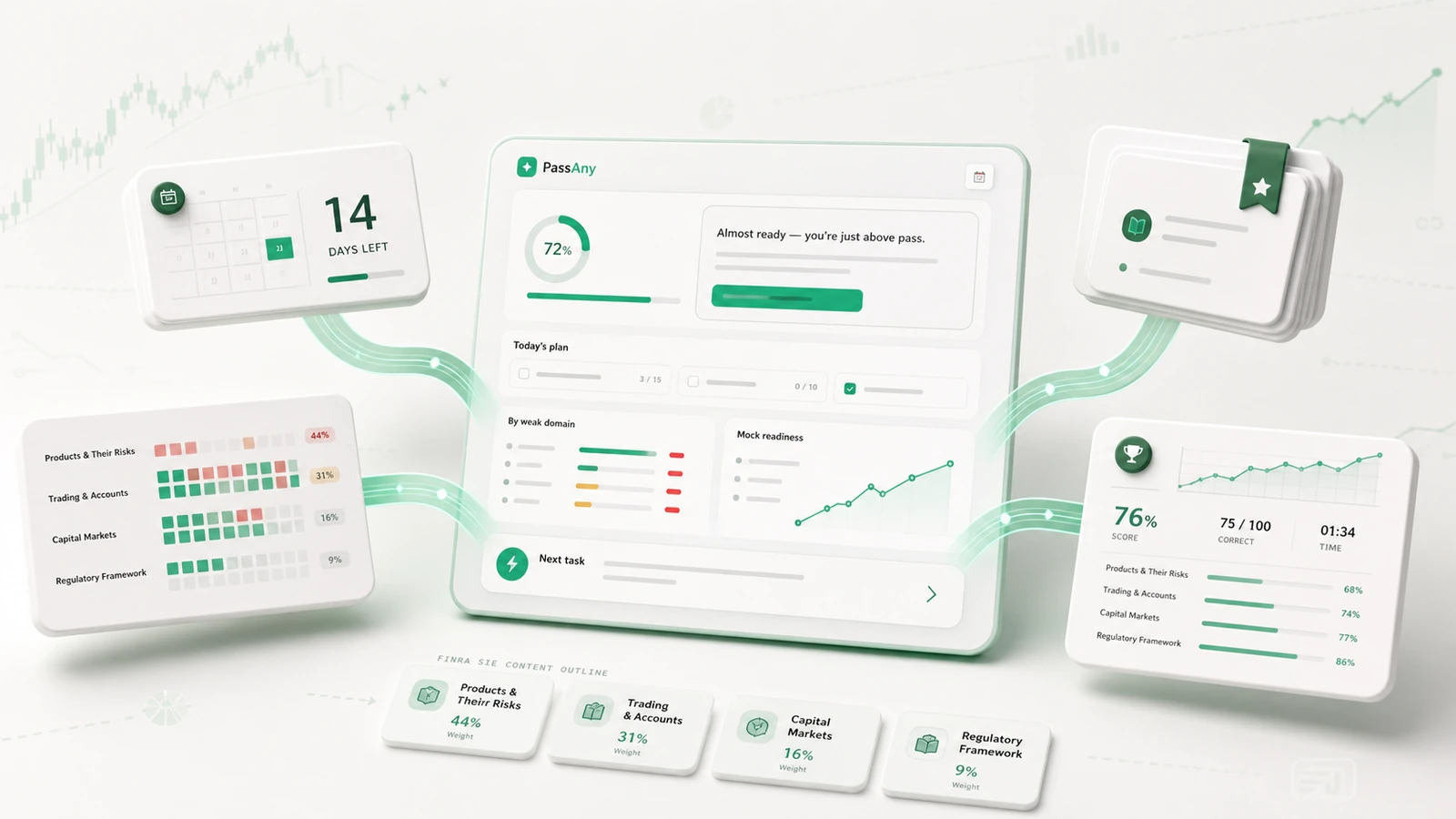
Every day already has a plan — and today is a short list.
No staring at a blank week. Each day mixes question practice, due flashcards and, as exam day nears, a timed mock. Today is broken into a few focused tasks with time estimates, so you always know what "done for today" looks like.
- A seven-day schedule, not a vague to-do
- Practice, flashcards and mocks balanced across the week
- Today's tasks ordered by what helps most
- Time estimates so a session fits real life
A clear path from "just started" to "ready to sit it."
The plan sets checkpoints between today and your exam, so progress is a path you can see — not an open-ended grind.
First full pass
Every FINRA topic seen at least once, so nothing is a complete blind spot.
Master the weak domain
Bring your lowest domain up to a solid mastery level before moving on.
Clear a full mock
Score above the passing line on a complete, timed 75-question paper.
Taper & confirm
Final review and a couple of confidence mocks in the days before the exam.
The plan isn't fixed. It moves with you.
You don't rebuild it by hand. As your results come in, the plan re-sorts what matters — so the next task is always the one that helps most.
Use it with
Useful for searches like
- SIE study plan
- How to study for the SIE exam
- SIE study schedule by exam date
- What to study first for the SIE
SIE study plan questions
How do I make a study plan for the SIE exam?
What should I study first for the SIE?
Can the plan change if I fall behind?
How do I know I'm ready for the SIE?
Stop guessing what to study next.
Start with free practice. As your scores come in, the plan starts telling you what to do each day.